
MCD Analysis – Analytic Hierarchy Process (AHP) Tutorial
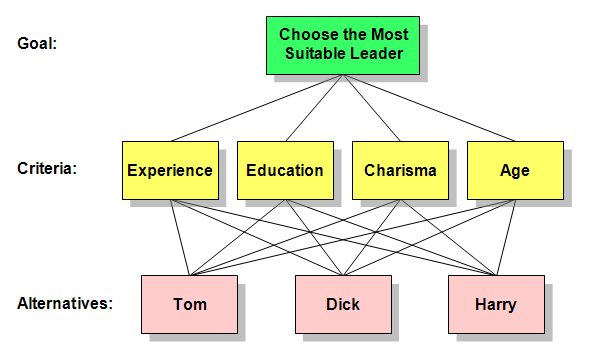
Let’s go through a simple, existent example published on Wikipedia to understand how the AHP really works. Imagine that we need to select a new CEO for a traditional, big company. The board of directors has selected three possible candidates (Tom, Dick and Harry), but they are struggling to decide who will be the new CEO since some BOD members aren’t sure which skills should be prioritized in this process.

According to the AHP, the first step is to define a hierarchy of sub-criteria that we can use to compare the options. In this case, the board decided that the four main criteria should be: Experience, Education, Charisma, and Age.
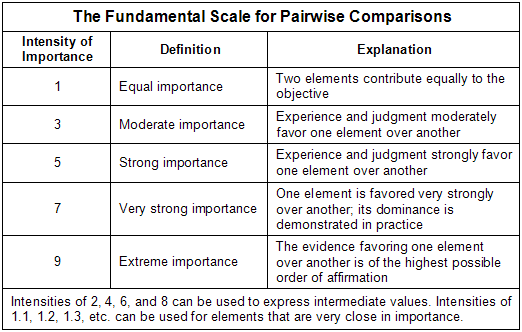
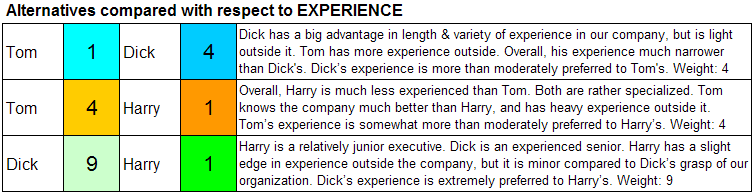
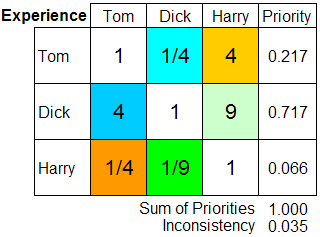
Having defined the criteria, we now need to start comparing the options pairwise. In order to do that, we are going to create a WCM, Weight Comparison Matrix, for each criterion. This will measure the relative degree to which each option of the pair accomplishes this specific criterion. The WCM is a square NxN matrix, where N is the number of options that we have, in this case 3. The values of this matrix should be filled by comparing the column number option with the line number option in the given criterion, and these values should be defined using the fundamental scale for pairwise comparisons.
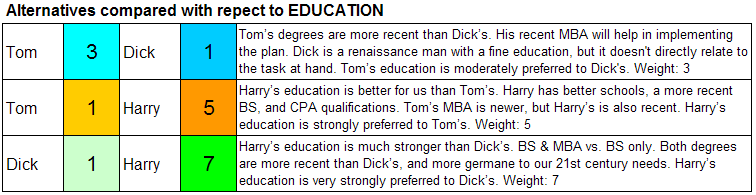
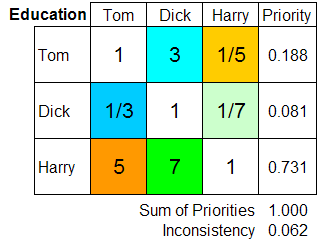
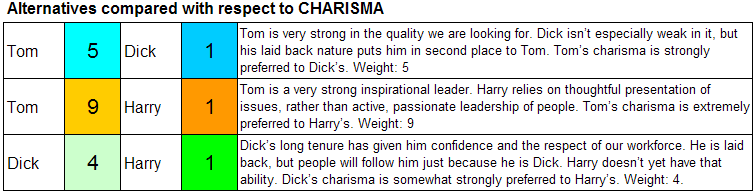
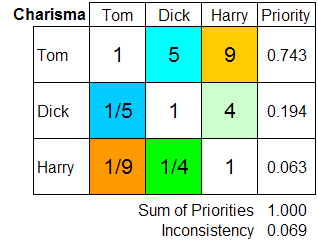
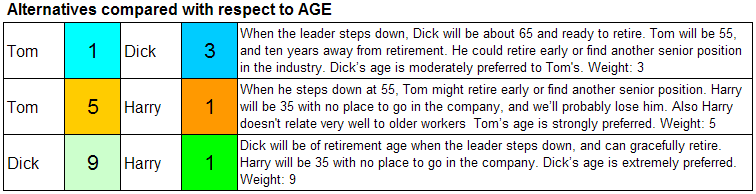
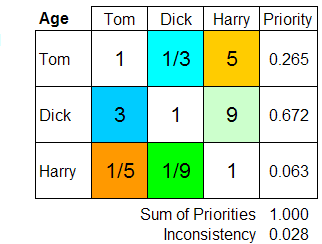
After defining the WCM of each option for each criterion, we now need to calculate the importance between the criteria themselves. We are going to use the same pairwise comparison method, but using a CxC WCM, where C is the number of criteria.

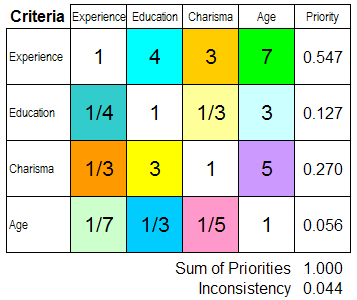
Now for our final step, we are going to calculate the criterion weight by multiplying each criterion priority by the corresponding option priority. Then, we sum all the weighted criteria by option, having a final score for each option over the main goal.

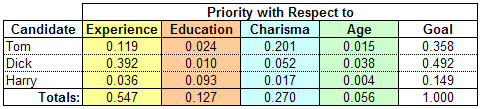
Based on the board’s choice of decision criteria and their judgment about the relative importance of each one, Dick, with a priority of 0.492, is by far the most suitable candidate. Tom, with a priority of 0.358, is second, and Harry, at 0.149, is third.
Benefits of Using AHP
Not only do our board members now have a logical decision, but also, because they have used the AHP, it is easy for them to trace their thinking and to justify the steps that led to their decision. If they have second thoughts about the final outcome, they can revisit the process and make changes if needed. They can also, if they deem it helpful, reveal the details of their process to their consultants, candidates, stakeholders, or to anyone else who might be concerned with the decision.